The Masks We Wear: From Corporate Chaos to Motherhood Burnout
The people around you are almost never exactly who they appear to be. We like to believe we can “read” others — through their expressions, their words, their behavior. But the truth is… very often, we are wrong. Because people don’t always show what they truly feel. Someone may be smiling… while falling apart inside. Another may seem calm… while carrying enormous tension within. And sometimes the strongest people are the ones hiding the deepest pain.
Strange, isn’t it? But what’s even more interesting is this: we do the very same thing. We don’t always cry when we are sad. We don’t always laugh when we are happy. Sometimes we do exactly the opposite — without even realizing why. Little by little, we begin to play roles. And after a while, we forget they are only roles.
As a woman who spent years in the corporate world as an accountant and head of internal audit, the topic of hiding our true selves is painfully familiar to me. That is exactly what provoked me to start writing my satirical book, The Masks We Wear at Work. But today, I want us to take off the corporate suit and look at these masks through the lens of daily life, motherhood, and our emotional resilience.
Why do we choose to become someone else instead of ourselves?
What Social Masks Really Are
They function as psychological mechanisms for protection, adaptation, and self-presentation. We put them on to hide our vulnerability and to fit into a world that often feels too critical and too demanding. Choosing a social role that doesn’t reflect our true self is often a sign of insecurity and a deep dependence on other people’s opinions. Sometimes we follow expectations that are not truly ours, just to avoid criticism.
It’s important to make one thing clear: good manners, values, and social awareness are signs of emotional maturity. They help us live together as a society. The mask we are talking about today is something different. This kind of mask slowly disconnects us from who we really are. According to the work of Lise Bourbeau, our unhealed emotional wounds can quietly shape our lives from behind the scenes.
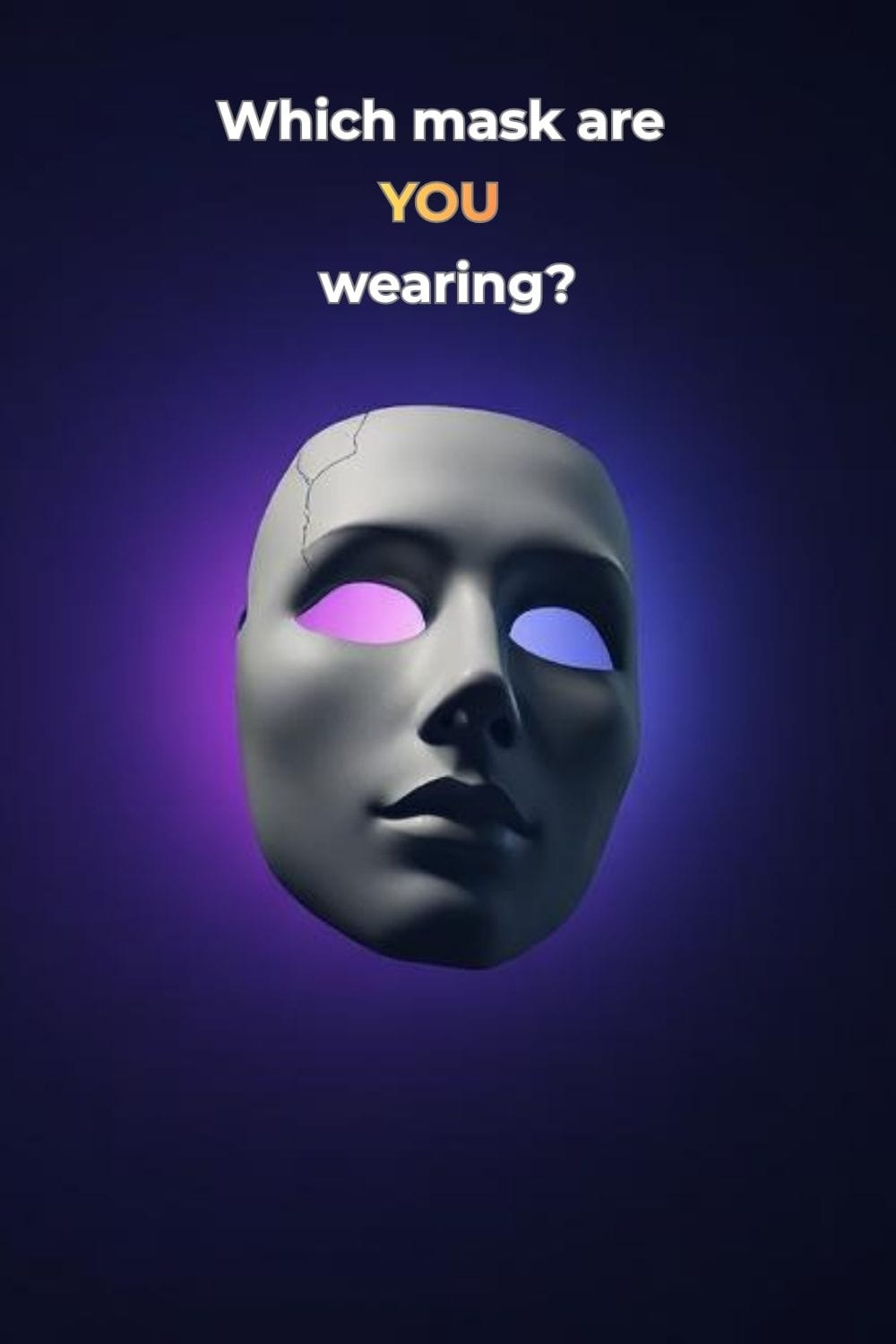
This process often begins in childhood. As children, we quickly learn that being completely natural is not always “acceptable.”
When we are told that something about us is wrong, we create a new version of ourselves — a mask — so we can become what others expect us to be. And this happens automatically. Unconsciously. Like a reflex. No one wakes up in the morning thinking: “Which mask should I wear today?”
The system works perfectly without us even noticing it. It becomes our survival software.
Today, we begin decoding the masks.
1. The Mask of the Runner (The Wound of Rejection)
People who wear this mask often live with a quiet inner belief: “I don’t belong here,” “I am different,” “There must be something wrong with me.” Because of this belief, they try to become invisible. Not physically invisible— emotionally invisible. They avoid attention, confrontation, and situations where they might be judged, criticized, or rejected. Very often, they escape into imagination, into books, into inner worlds that feel safer than reality.
Perfectionism is also common here, because somewhere deep inside, there is a belief that love must be earned. So they try harder. They become quieter, better, more careful, less noticeable. But the truth is— this is not weakness. This is protection. The Runner learned very early in life that being fully present felt unsafe, so instead, they learned how to disappear. But the moment you recognize this pattern, you already begin changing it. Awareness is always the first step toward healing.
2. The Mask of the Dependent (The Wound of Abandonment)
People who carry this wound often live with a deep inner fear: “I cannot manage on my own.” Their emotional world is strongly connected to the presence of others. Relationships become their main source of safety, reassurance, and stability.
Because of this, they often take on one of two roles: the rescuer or the one who needs rescuing (sometimes both). They may become extremely caring, deeply devoted, and always available for others. But behind this devotion there is often a quiet fear: “If I am not needed, I might be left.” Healing begins the moment a person discovers something powerful: the safest place they can return to is themselves.
3. The Mask of the Controller (The Wound of Betrayal)
Having spent years in audit and administration, the need for control is incredibly clear to me. People who wear this mask often develop a strong need for control, clarity, predictability, structure, and certainty. Because uncertainty once hurt them deeply. Trust becomes difficult. Delegating responsibility becomes difficult. Relying on others becomes difficult.
Instead, they rely on themselves. They organize everything, plan everything, anticipate everything. They appear confident, strong, and decisive, but beneath this strength there is often a hidden fear: “What if I am disappointed again?” They learned an important lesson: “If I stay in control, I stay safe.” (This is exactly why today, in my new relationship, I consciously practice open communication and delegating responsibilities at home). Control is not safety. Control is protection, and protection is only needed where trust once disappeared. Healing begins when control slowly transforms into confidence. Confidence in life, confidence in others, and most importantly— confidence in oneself.
4. The Mask of the Masochist (The Wound of Humiliation)
This is the classic trap many mothers fall into. People who carry this wound often develop a strong tendency to put others before themselves. They help, support, give, and sacrifice. Sometimes endlessly. From the outside, this looks like kindness, generosity, and devotion. But deep inside, there may be a fear of shame, a fear of being judged, a fear of being seen as selfish.
So they take responsibility for everyone, carry burdens that are not theirs, and forget their own needs. Sometimes they even deny themselves pleasure. Rest feels undeserved, joy feels suspicious, ease feels unfamiliar. The mask is a silent promise: “If I take care of everyone else, no one will shame me again.” True healing begins the moment a person understands: their worth does not depend on how much they give to others.
5. The Mask of the Rigid (The Wound of Injustice)
People who wear this mask often appear strong, disciplined, reliable, and controlled. They value structure, fairness, precision, and responsibility. They expect a lot from themselves—sometimes too much. They rarely allow themselves to make mistakes or to slow down.
Very often, they hide their emotions, because somewhere deep inside, they learned that feelings create chaos and vulnerability creates risk. The child learned: “I must be perfect to be valued.” The mask became strength, but also distance. Distance from emotions, distance from softness, distance from themselves. Healing begins when a person allows themselves to be human— not perfect.
The Courage to Take Off the Mask
These steps may sound simple on paper, but in real life, they are not easy at all. I know this personally because I am walking this path too.
Several years ago, while searching for myself again, I found the courage to join a psychotherapy group. For the first time, I allowed myself to relax, to share honestly, and to understand the inner mechanisms that had guided me for so many years. That moment changed my life, and the journey continues even today. I still attend the group and continue working with a personal consultant who has become one of the most important sources of support in my life—someone I trust deeply, someone I can speak with without fear of judgment.
I am sharing all of this with you because recognizing our wounds is important, but trying to heal them alone is much harder than it needs to be. If you can, trust a professional—a psychologist or a therapist—someone who can walk beside you on your path toward healing.
You deserve to live without masks. The key to happiness is the freedom to be yourself, to shine with your own light— instead of reflecting someone else’s. No mask can be worn forever without becoming heavy and painful. Let us take responsibility for our own healing. Because the moment you put down the shield, you begin to feel something extraordinary: the lightness of simply being yourself.
Thank you for being here with me.
💬 Which “mask” weighs most heavily on you in your life today?
Share it with me via email or send me a message using the contact form—let’s talk about it together.